HOVERAir VERSA: Is the Flying Pocket Camera a New Creator Camera Category?
Most pocket gimbal cameras stay in your hand. Most drones only become useful after they leave it. HOVERAir VERSA is trying to remove that divide.
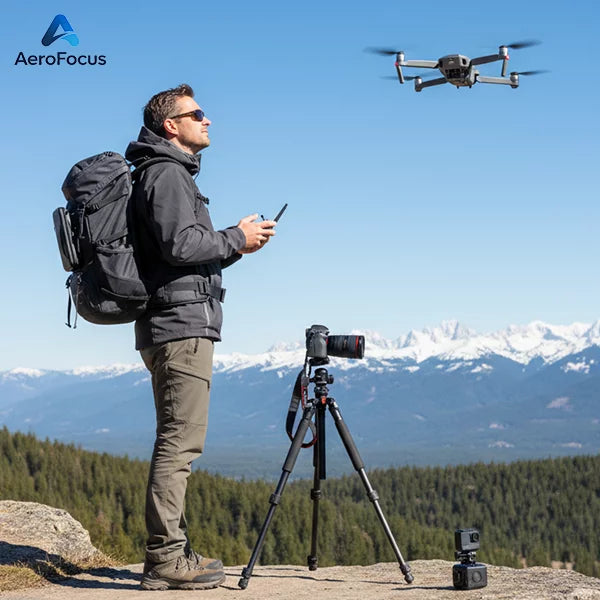
In handheld mode, VERSA works as a compact 3-axis gimbal camera for vlogging and everyday filming. Attach the Flight Kit, unfold the arms, and the same camera becomes a self-flying third-person camera for follow shots, orbiting views and automated aerial footage.
That makes VERSA more interesting than a normal product launch. The bigger question is whether it points toward a new creator-camera category: one camera that moves between first-person handheld shooting and autonomous third-person capture.
Quick answer
VERSA is not simply a pocket camera with drone accessories. Its main idea is perspective switching: use it as a handheld gimbal camera on the ground, then attach the Flight Kit when you want the camera to move away from you and film from the air. That combination could create a new middle ground between pocket gimbal cameras and compact self-flying cameras.
Editor’s note: This article is based on HOVERAir’s published specifications and launch information. It is a market and product-category analysis, not a hands-on review.

What Is HOVERAir VERSA?
HOVERAir describes VERSA as a self-flying pocket camera. The handheld camera module uses a 3-axis mechanical gimbal and a 1/1.3-inch image sensor. In handheld mode, it records like a compact creator camera. Add the 67g Flight Kit and the system becomes a 230g flying camera with AI tracking and more than ten intelligent flight modes.
The conversion is the important part. According to HOVERAir, the Flight Kit connects through its MagLatch magnetic and mechanical locking system, allowing the camera to move between handheld and flying use within seconds.
That creates two very different shooting roles from one camera:
- Handheld mode: first-person vlogging, walking shots, travel clips, family footage and ground-level creator work.
- Flying mode: third-person follow shots, orbiting footage, automated tracking and wider environmental perspectives.
The concept is simple, but strategically important: instead of carrying one camera for the ground and another camera for the air, VERSA tries to make the same imaging system do both jobs.
HOVERAir VERSA Key Specifications

| Handheld camera weight | 163g |
| Flight Kit weight | 67g |
| Flying configuration | 230g |
| Image sensor | 1/1.3-inch |
| Video | Up to 4K/60fps; 10-bit HDR and H-Log supported |
| Stabilization | 3-axis mechanical gimbal |
| Handheld runtime | Up to 180 minutes |
| Flight time | Up to 14 minutes |
| Max horizontal speed | 36 km/h |
| Storage | 64GB built-in + microSD up to 1TB |
On paper, those specifications do not make VERSA the most extreme pocket camera or the most capable traditional drone. Its advantage is the ability to change shooting perspective without changing cameras.
Why VERSA Is Different From a Normal Pocket Camera
A conventional pocket gimbal camera is excellent when the creator controls the frame directly. You hold it, place it on a tripod, mount it somewhere, or ask another person to operate it.
VERSA adds another option: the camera can leave your hand and become the camera operator.
That matters most for solo creators. A traveler walking through a landscape, a cyclist riding alone, or a creator filming an outdoor sequence normally has to choose between a handheld point of view and a separate drone setup. VERSA is designed to move between those two perspectives with much less equipment.
The key idea: a pocket camera records what you point it at. A self-flying camera can move away from you and record you inside the scene.
VERSA vs DJI Pocket 4P vs Insta360 Luna Ultra: Three Different Directions

VERSA becomes even more interesting when placed next to the new generation of pocket creator cameras. The comparison is not only about resolution, sensor size or frame rate. These products represent different ideas about what a small creator camera should become.
| Product Direction | Core Idea | Main Strength | Best Fit |
|---|---|---|---|
| DJI Pocket 4P | Ground-first pocket gimbal camera | Dedicated handheld creator workflow | Vlogging, travel, controlled handheld shooting |
| Insta360 Luna Ultra | Flexible pocket creator system | High-spec imaging and creator-oriented shooting modes | Creators who prioritize imaging flexibility |
| HOVERAir VERSA | Handheld + self-flying camera | Switching from first-person to third-person capture | Solo creators, travel and outdoor storytelling |
This is why we would not describe VERSA as a direct replacement for Pocket 4P or Luna Ultra. The better question is: which perspective matters more to your workflow?
If maximum ground-based camera control is the priority, a dedicated pocket gimbal may still be the better tool. If you frequently film alone and want the camera to follow, orbit or move away from you without adding a separate drone, VERSA offers something fundamentally different.
Does VERSA Replace a Pocket Camera, a Drone—or Neither?
The most realistic answer is: VERSA sits between them.
Where VERSA can replace part of a pocket-camera workflow
For travel, everyday vlogging and handheld creator work, VERSA can perform the familiar role of a stabilized pocket camera. Its 3-axis gimbal, vertical recording support and long handheld runtime make that side of the product more than an afterthought.
Where VERSA can replace part of a drone workflow
For automated follow shots, orbiting shots and simple third-person aerial perspectives, the Flight Kit can remove the need to carry a second small flying camera.
Where VERSA still does not replace a conventional drone
VERSA is built around self-flying creator shots rather than full traditional drone operation. HOVERAir also states that VERSA does not actively detect obstacles, brake for them or steer around them. Clear, open environments remain important.
Its 14-minute rated flight time is also much shorter than the endurance expected from larger camera drones. In other words, VERSA should be viewed as a flying creator camera first, not as a replacement for every conventional drone use case.
Who Is HOVERAir VERSA Actually For?
VERSA makes the most sense for creators whose biggest limitation is not image quality alone, but getting enough perspectives while filming by themselves.
- Solo travelers: switch between handheld vlog footage and third-person travel shots without carrying two complete camera systems.
- Outdoor creators: add follow and orbit footage to walking, cycling or adventure sequences.
- Family and lifestyle users: move from handheld moments to wider group or environmental shots.
- Short-form creators: capture more visual variety for Reels, TikTok, Shorts and social storytelling.
- Tech-forward creators: experiment with a modular camera format that does not fit neatly into the traditional “camera” or “drone” category.
It is less compelling for someone who rarely wants third-person footage. If nearly all of your work is handheld, studio-based or tripod-based, a dedicated pocket gimbal camera may offer a simpler workflow.
The Trade-Offs: What VERSA Still Compromises
A product that combines two categories will inevitably make compromises.
- Flight time: up to 14 minutes is useful for short automated shots, but it is not long-duration drone endurance.
- Open-space requirement: because VERSA does not actively avoid obstacles, self-flying shots still require environmental awareness.
- Two configurations: the Flight Kit adds capability, but users still need to attach, carry and manage the flying hardware.
- Regulations still matter: a lightweight flying camera is still subject to local aviation, privacy and location rules. Being under 250g does not automatically mean unrestricted use everywhere.
- Specialization: a dedicated pocket camera or dedicated camera drone may still outperform a hybrid product in the job it was designed specifically to do.
That does not weaken the VERSA concept. It simply clarifies the target user: someone who values perspective flexibility and reduced gear switching more than having the most specialized tool for each individual shot.
The Bigger Story: Are Pocket Cameras and Drones Starting to Merge?
VERSA is interesting because it changes what “compact creator camera” can mean.
For years, camera categories were easy to separate. Action cameras were rugged and wide. Pocket gimbal cameras were stabilized and handheld. Drones created aerial footage. 360 cameras captured everything around them and reframed later.
Those boundaries are becoming less clear.
Creator cameras now compete less on one specification and more on how many useful perspectives one person can capture with minimal setup. VERSA takes that trend to its logical next step: instead of asking the creator to reposition the camera, it gives the camera the ability to reposition itself.
That could matter well beyond HOVERAir. If creators respond positively to the format, other camera brands may explore more modular systems, smarter autonomous tracking, detachable capture modules or accessories that move a camera between handheld, mounted and aerial use.
VERSA may not be the best pocket camera or the best drone in isolation. Its advantage is that it can be both.
What VERSA Could Mean for the Accessory Market

The accessory side may become one of the most interesting parts of the VERSA ecosystem because the product combines requirements from both pocket cameras and flying cameras.
Some categories are already visible in HOVERAir’s launch ecosystem. VERSA supports swappable batteries and a Charging Hub, optional ND8/16/32/64 filters and a Black Mist Filter, a Multi-Purpose Tripod with a standard 1/4"-20 interface, a MiCo mini controller, suction and mounting accessories, and a repair kit.
That already creates several accessory groups:
- Power: spare batteries, charging hubs and travel charging organization.
- Imaging: ND filters, mist filters and lens protection.
- Mounting: tabletop tripods, selfie sticks, suction mounts, backpack clips and standard 1/4"-20 accessories.
- Flight: Flight Kit protection, repair parts and controller accessories.
- Storage: compact camera cases and larger all-in-one cases for the camera, Flight Kit, batteries, filters and charging accessories.
For third-party accessory brands, the key opportunity is likely to be configuration-based storage. A handheld-only user needs something very different from a creator carrying the camera, Flight Kit, multiple batteries, filters, controller and mounts.
That is the same pattern we already see in mature action-camera and pocket-camera ecosystems: once the core device becomes popular, users quickly begin optimizing how they protect, power, mount and carry it.
What Should Retailers Watch Next?
VERSA is still an early product ecosystem, so retailers should avoid treating every possible accessory as a guaranteed opportunity. The better approach is to watch what users actually add to their setup after the camera begins shipping at scale.
The categories worth monitoring first are:
- protective storage for handheld-only users
- all-in-one cases for the camera + Flight Kit
- battery and charging organization
- filter storage and lens protection
- tripods, extension poles and 1/4"-20 mounting accessories
- controller and travel accessories
For B2B accessory sellers, the most important question is not “How many VERSA accessories can we list?” It is which accessory solves a clear problem created by the hybrid camera format.
Related: Pocket Creator Cameras Are Already Changing
If VERSA represents the “camera that can fly” direction, DJI and Insta360 are pushing the pocket creator category in different ways. Our earlier comparison looks at two of the most important ground-based creator cameras in this new generation.

FAQ About HOVERAir VERSA
Is HOVERAir VERSA a drone or a pocket camera?
It is designed to work as both. In handheld mode, VERSA is a 3-axis gimbal camera. With the Flight Kit attached, it becomes a self-flying camera with AI tracking and automated flight modes.
How much does HOVERAir VERSA weigh?
The handheld camera weighs 163g, the Flight Kit weighs 67g, and the complete flying configuration is rated at 230g.
What video resolution does VERSA support?
VERSA records up to 4K/60fps and supports 10-bit HDR and H-Log. HOVERAir also lists vertical video support up to 4K/60fps.
How long can HOVERAir VERSA fly?
HOVERAir rates flight time at up to 14 minutes per battery. Handheld operation is rated at up to 180 minutes under the company’s test conditions.
Does HOVERAir VERSA have obstacle avoidance?
No active obstacle avoidance is listed. HOVERAir says VERSA does not actively sense obstacles, brake or steer around them, so it should be used in clear environments with proper awareness of the surroundings.
Can VERSA replace DJI Pocket or Insta360 Luna Ultra?
Not necessarily. VERSA prioritizes switching between handheld and self-flying perspectives. DJI Pocket and Insta360 Luna cameras may still be better fits for creators who mainly prioritize dedicated ground-based filming. The right choice depends on whether third-person autonomous capture is central to your workflow.
What accessories are available for HOVERAir VERSA?
The launch ecosystem includes batteries, a Charging Hub, ND filters, a Black Mist Filter, a Multi-Purpose Tripod, MiCo controller, mounting accessories and a repair kit. More third-party protection, storage and mounting accessories are likely to appear as adoption grows.
Final Take: VERSA Is More Important as an Idea Than as a Spec Sheet
The most important thing about HOVERAir VERSA is not that it has a 1/1.3-inch sensor, records 4K/60fps or weighs 230g in flying configuration.
It is the idea that a creator should not have to choose between holding the camera and being filmed by the camera.
That is why VERSA deserves attention even from creators who may never buy one. It challenges the traditional separation between pocket cameras and compact drones, and it could influence how future creator-camera systems are designed.
For accessory brands and retailers, it also opens a new question: if one camera can operate in multiple physical configurations, the next accessory opportunity may not be a single case, mount or battery product. It may be an entire ecosystem built around switching between those configurations quickly and safely.
AeroFocus Is Watching the Next Creator-Camera Ecosystem
We track new creator cameras and accessory opportunities across DJI, Insta360, HOVERAir, GoPro and other emerging platforms. Retailers and distributors interested in future accessory sourcing can contact our wholesale team.
Email: wholesale@aerofocus.store
WhatsApp: +86 18487651523
Availability note: VERSA launched through crowdfunding in 2026. Specifications, bundles, supported accessories, firmware features and regional availability may change as the product moves into broader retail distribution. Always check the latest regional information before purchase or flight.